Rust / Guide
Cloning and crossbreeding in Rust: how to breed a godclone
Read genes, save clones, crossbreed in a large planter: the rules behind every cross and a routine that turns random seeds into GGGYYY.
In short
- Every plant has six genes. GG growth, YY yield and HH hardiness are good, WW water use and XX empty are bad.
- Seeds get random genes when planted. A clone is an exact copy of its plant – that is how you keep good genes.
- Crossbreeding happens once per plant, in the “Crossbreed” growth stage, and only with neighbouring plants of the same kind in the same planter. Plant the centre clone first so it is the first to crossbreed.
- Rule of thumb: if the same green gene appears twice on one gene slot around a plant, it beats any red gene in the centre.
- The target is almost always the godclone GGGYYYGGGYYY. ClonePilot works out which of your clones to plant around the centre.
Reading the six genes
Look at a planted plant or hover over a clone or seed in your inventory: under “Genetics” you see six coloured letters. Green is good, red is bad. The order does not change the effect – it only matters when crossbreeding, because that compares slot by slot.
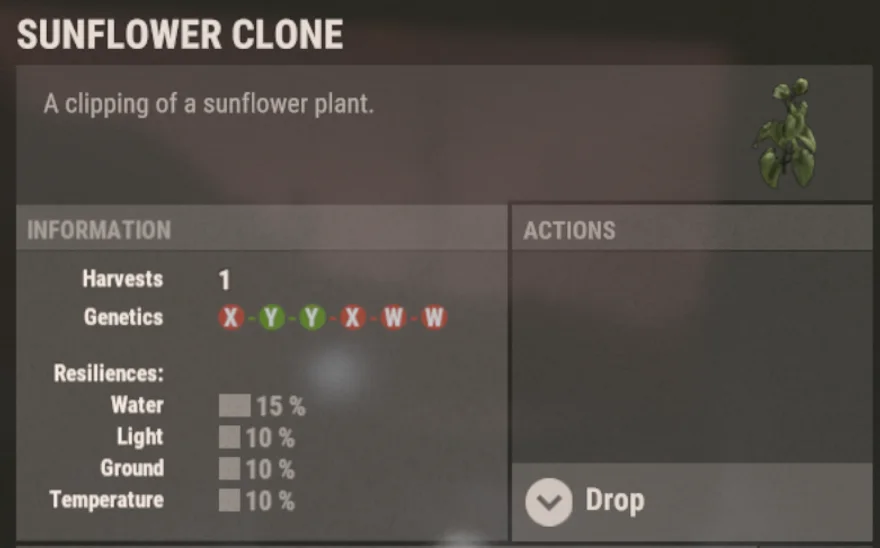
| Gene | Meaning | Effect |
|---|---|---|
| GG | Growth | The plant grows faster. |
| YY | Yield | More harvest and more clones per plant. |
| HH | Hardiness | Copes with worse conditions, mainly temperature. Rarely needed in a heated indoor farm. |
| WW | Water | The plant needs more water. |
| XX | Empty | No use. It just takes a slot. |
Seeds get random genes, clones keep them
A seed has no fixed genes yet. They are generated at random when you plant it – so even the seed from a crop of your best clone does not inherit its genes, but gets random genes when planted. A clone, on the other hand, copies its plant's genes exactly. That is why every breeding run works the same way: plant many seeds, clone the best plants, crossbreed the clones on purpose.
| Plants | How you get seeds | More seeds |
|---|---|---|
| Berries, pumpkin, corn, potatoes | Pick the wild plant: 1 seed and 1 crop. Every crop you eat gives 1 seed – whether from the wild or from your planter. | Any time: harvesting a planter gives no seeds, but every crop you eat does. A wild plant thus yields 2 seeds. |
| Hemp, sunflower, rose, orchid | Pick the wild plant: exactly 1 seed. These plants cannot be eaten. | Only in the wild – harvesting a planter gives no seeds. |
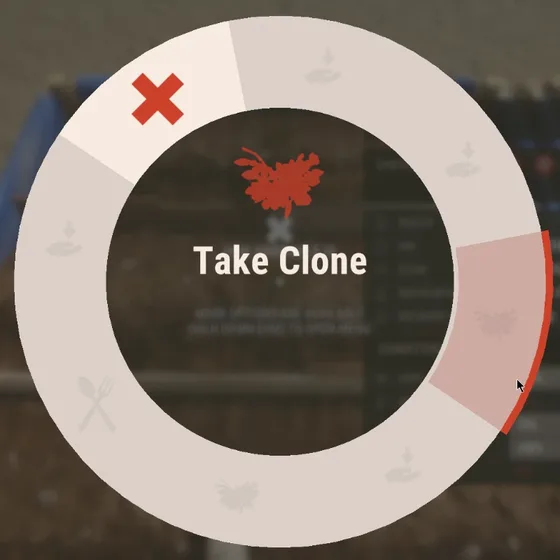
- Hold E on a planted plant and choose Take Clone in the radial menu. This works from the Sapling growth stage on, but not during Crossbreed.
- To save the genes before crossbreeding, clone at Sapling. To keep the result of a cross, clone from Mature on.
- More YY means more clones per plant: with four YY you get 4 clones, with three or two YY 3 clones. You always get at least 2 clones, even without any YY.
- Label your boxes or enter the clones in ClonePilot – after three generations nobody remembers which clone was which.
How a cross is decided
Every plant goes through the stages Seed, Seedling (after about half a minute to a minute), Sapling (after around 8 minutes, longer depending on the number of GG), Crossbreed, Mature, Fruiting and Ripe. Only in Crossbreed does it take on genes – from every neighbouring plant, horizontally, vertically and diagonally. The centre of a large planter can thus receive genes from up to eight neighbours. After that its genes are fixed. Important: it is always the plant currently in Crossbreed that crosses. The neighbours only give – which is why the centre has to get there first.
- Who counts: only plants that touch it directly – diagonals included – in the same planter and of the same kind. Red and blue berries are different kinds.
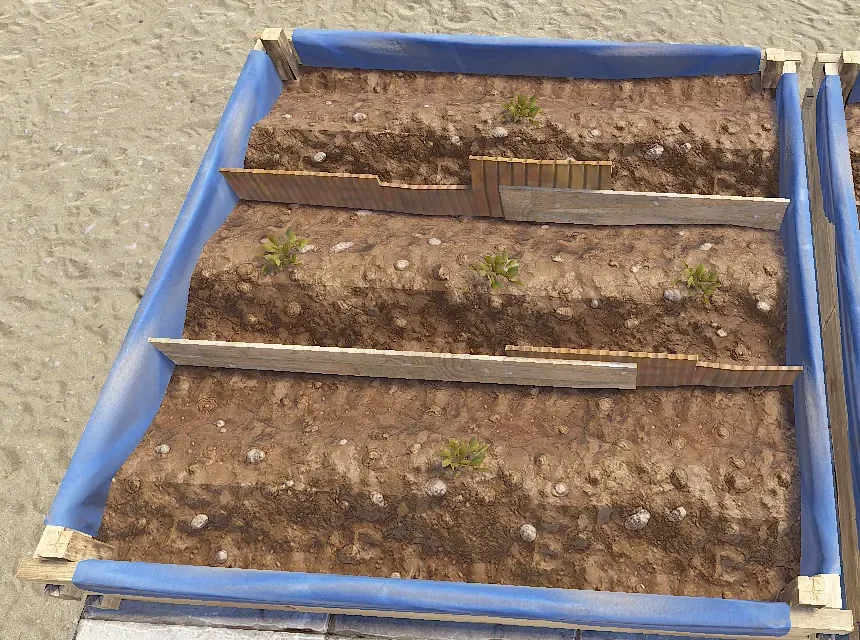
- How many: in a large planter (3 × 3) the centre has eight neighbours, an edge slot five, a corner three. That is why you almost always breed in the centre.
- Weight: every green gene of a neighbour counts 0.6, every red one 1.0. Matching genes on the same slot add up.
- Who wins: on each slot the gene with the highest total wins – but only if that total is higher than the weight of the gene the centre already has there. Otherwise the slot stays as it is.
- Ties: if two genes share the highest total, chance decides (50 : 50).
Example: four average clones become GGGYYY
None of the four donors is perfect, each has one weak gene. Because the weaknesses sit on different slots, the right gene appears three times on every slot (3 × 0.6 = 1.8) – more than any single red gene (1.0). The centre is guaranteed to become GGGYYYGGGYYY, whatever seed or clone is planted there.
- empty
- GGXYYHGGXYYH
- empty
- XGGYHYXGGYHY
- Centreany
- GHGYYYGHGYYY
- empty
- GGGXYYGGGXYY
- empty
| Donor | ||||||
|---|---|---|---|---|---|---|
| Top donor | GG | GG | XX | YY | YY | HH |
| Left donor | XX | GG | GG | YY | HH | YY |
| Right donor | GG | HH | GG | YY | YY | YY |
| Bottom donor | GG | GG | GG | XX | YY | YY |
| Result | GG | GG | GG | YY | YY | YY |
Slot 1: GG 3 × 0.6 = 1.8 · XX 1 × 1.0 = 1.0 → GG
Step by step to a godclone
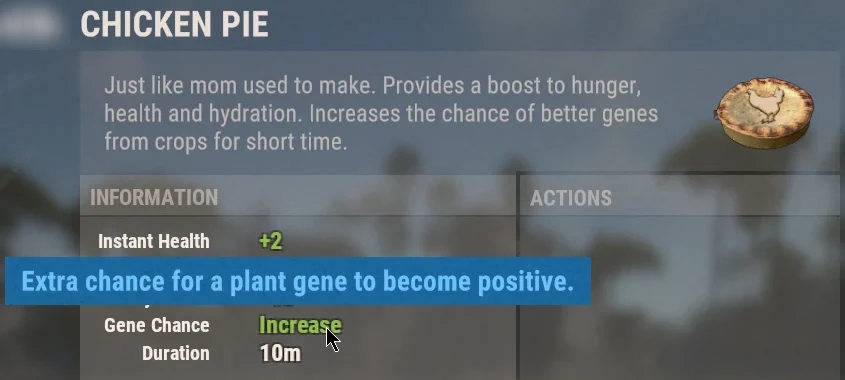
- Collect and plant seeds. Eat a Chicken Pie first and plant within the next 10 minutes. Start with 48 seeds – one full box for ClonePilot. Add more seeds if the genes are not enough for your target.
- Clone good plants. Keep anything with at most one red gene and plants whose green genes sit on different slots. Clone them at the Sapling stage.
- Enter the clones in ClonePilot. “Scan Rust” reads the genes straight from your screen, or you type them in by hand.
- Pick a target and calculate. ClonePilot shows which clones to plant around the centre and how certain the result is (100% or 50%).
- Plant the centre first. Put the centre clone alone into a large planter. Wait 10–15 minutes until it is at Sapling 30% or more – whether 30, 60 or 80% does not matter. Only then plant the donors around it. That way the centre reaches Crossbreed first and takes on the donors' genes.
- Check the result and clone it. Once the centre is Mature, look at its genes. If the result is right, take clones and store them – that is your new stock.
- Repeat. If your donors are not good enough, ClonePilot first suggests an intermediate clone (Gen 2). Use it to keep crossing in the next round.
Which target suits you?
| Target | Best for | Clones per plant |
|---|---|---|
| GGGYYYGGGYYY | The godclone and the most effective choice for every plant if you harvest right at Ripe. The optimum for berries: three YY already give 5 berries, a fourth YY adds none. | 3 |
| GGYYYYGGYYYY | More yield, but slower growth. Pays off for pumpkin, corn, potatoes, hemp and flowers if you do not harvest right at Ripe – for example because you are out. No advantage for berries. Gives one more clone. | 4 |
| GGGGYYGGGGYY | Ready fastest, less yield. For short sessions and frequent harvests. | 3 |
| with HH | Only useful outdoors in cold or heat. In a sheltered, heated farm H wastes a slot. | – |
Light, water, ground, temperature
Good genes only help if the plant is looked after. Rust rates light, water, ground and temperature separately – the worst value holds back the whole plant. A single weak spot costs more than an extra GG gains.
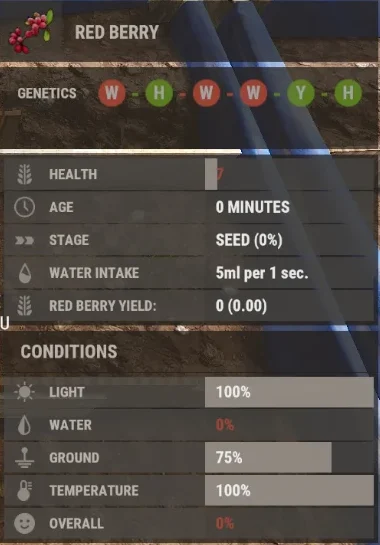
- Light: sunlight or ceiling lights. Without light, nothing grows.
- Water: sprinklers with fresh water. Run salt water through a water purifier first. Radioactive water kills plants.
- Ground: fertilizer from the composter sets ground to 100%.
- Temperature: in cold biomes and at night, heaters near the planters help.
Common questions
Does a GGGYYY plant give me GGGYYY seeds?
No. Eating a crop of your GGGYYY clone does give you a seed – but it gets random genes when planted. You only pass good genes on through clones.
Does the Chicken Pie really give better genes?
Yes, for 10 minutes every plant gene gets an extra chance to become positive – but nothing is guaranteed. According to the game, the Rich Chicken Pie (with 4 cream) works considerably better. For a godclone you still cannot skip targeted crossbreeding.
Do plants in two different planters crossbreed?
No. Only neighbours in the same planter count – even if two planters stand right next to each other.
Why did my cross not give the expected result?
Usually a neighbour was planted too early or too late, a different kind stood next to it, or a slot had a tie. Check the layout with ClonePilot – it marks 50% results explicitly.
Do I need W genes for more water?
No. W means the plant needs more water. It is a bad gene.
Do the times apply on every server?
No. Servers can change growth times. The 8–10 minutes until Sapling apply to default settings. So go by the stage the plant shows: only plant the donors once the centre is at Sapling 30% or more.